
I feel very unqualified this evening to talk about Outsider Art, I really do, but I want to post this anyway. I've been sitting on these paintings (ouch) for days, ever since I discovered Henry Darger on someone's Myspace page and realized that I absolutely adore him.

First of all, let me digress a little and say that I have a thing for 'Art of the Insane', not to be confused with folk art, but I suppose still lumpable under the blanket term Outsider Art, or at least art brut. Ever since I went to France in 1983 and was able to visit La Maison Picassiette, the home-turned-work of art of Raymond Isidore, I've been fascinated with this type of expression. Isidore was a gravedigger who lived just outside Chartres, and when he wasn't gravedigging, he was decorating the walls, floors, and furniture of his home with little bits of broken cutlery and glass.
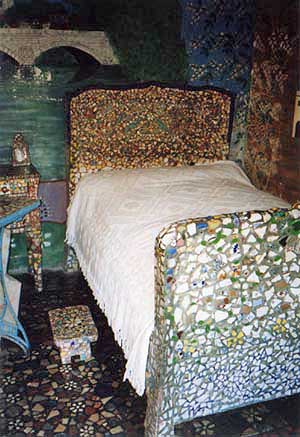 Raymond Isidore, Picassiette interior
This medium is known as shardware, or pique assiette, and while it's not such a big deal now, as a 22 year old, I thought it was the coolest thing ever. You could walk along concrete and broken glass pathways, and into the house decorated with broken glass, and sit at tables and chairs embedded with broken glass, then go into the chapel of concrete and broken glass...you get the idea. What was especially beautiful about Picassiette was that conceptually, it mirrored the larger and more well-known stained edifice in whose shadow it stood, the cathedral of Chartres, just more brut and muddy.
 Raymond Isidore, Picassiette gardens
 Raymond Isidore, Picassiette gardens
Anyway, it fascinated me. After coming back to Athens I soon ended up making the trek over to Paradise Gardens, where I experienced something very similar to Isidore's home, but larger and more elaborate. Not to mention that Howard's garden touched me on a much more primal level. The air was muggy, the plants in full bloom, and it being the end of summer, all was very lush, green and southern. As we walked through the steamy heat, I felt in certain ways like I was a kid at some summer gathering with my family.

Howard Finster, Paradise Garden
 Howard Finster, Paradise Garden
Fast forward (yes, I said that) to graduate school where I took a seminar (among many) on art movements in Paris following World War II. Here I encountered the artists who were associated with the Prinzhorn Collection, works of art by asylum inmates in the early part of the 20th century which had been collected by psychiatrist Hans Prinzhorn in Switzerland to be exhibited in a gallery and which were, in fact, later published in book form, greatly influencing other artists working at the time.

Now, the whole idea of a link between madness and creativity is nothing new, of course, but to actually view these paintings and drawings, looking for similarities, common themes and styles, and to begin to appreciate them as actual works of art was something eye-opening for me personally. Here were individuals compelled to create, driven to paint while confined to an asylum, most of them for their entire lives. Via their works they expressed their obsessions, their fears, their demons - each painter hinting at his 'illness' via the manner in which he painted.

Now, the whole idea of a link between madness and creativity is nothing new, of course, but to actually view these paintings and drawings, looking for similarities, common themes and styles, and to begin to appreciate them as actual works of art was something eye-opening for me personally. Here were individuals compelled to create, driven to paint while confined to an asylum, most of them for their entire lives. Via their works they expressed their obsessions, their fears, their demons - each painter hinting at his 'illness' via the manner in which he painted.
 Adolf Wolfli
So, last week I discover this artist, Henry Darger. He was a janitor, it seems, a recluse who lived in Chicago in the first half of the 20th century, and painted scenes of intricate patterns with fabulous visual geometric rhythm. He has a recurring theme in his work, a bunch of clone-like young girls called "The Vivians."

There is a lovely write-up on his life and his art on Sara Ayers' page, which I am just going to link here, since she writes about him so beautifully that there is no need to repeat it all here. Apparently this man, who had a wretched, isolated life, sometimes living on the street, sometimes eating out of garbage cans, had a rich, vivid, colorful fantasy life. When his landlady was cleaning out his room following his death, she found thousands of works of art he had done, paintings which depicted a fantasy world populated by young girls, often naked, often sexually suggestive, but depicted in such a way that it is clear that he was a very talented and thoroughly modern artist.


Which brings me to my last point: what is the relationship between madness and modernity? Why were artists of this era - roughly 1945 through the 1960's - drawn to art made by often institutionalized and always untrained artists? Where is the overlap between primitivism and modernity? Why did Dubuffet, Ernst, Klee and others strive to reach the level of purity found in these works, and what does that say about individual expression? What did modern painters have in common with inmates of insane asylums that was strong enough to give them a shared collective pool from which to draw inspiration?
I have my ideas, but I'll leave it up to y'all to talk now.


